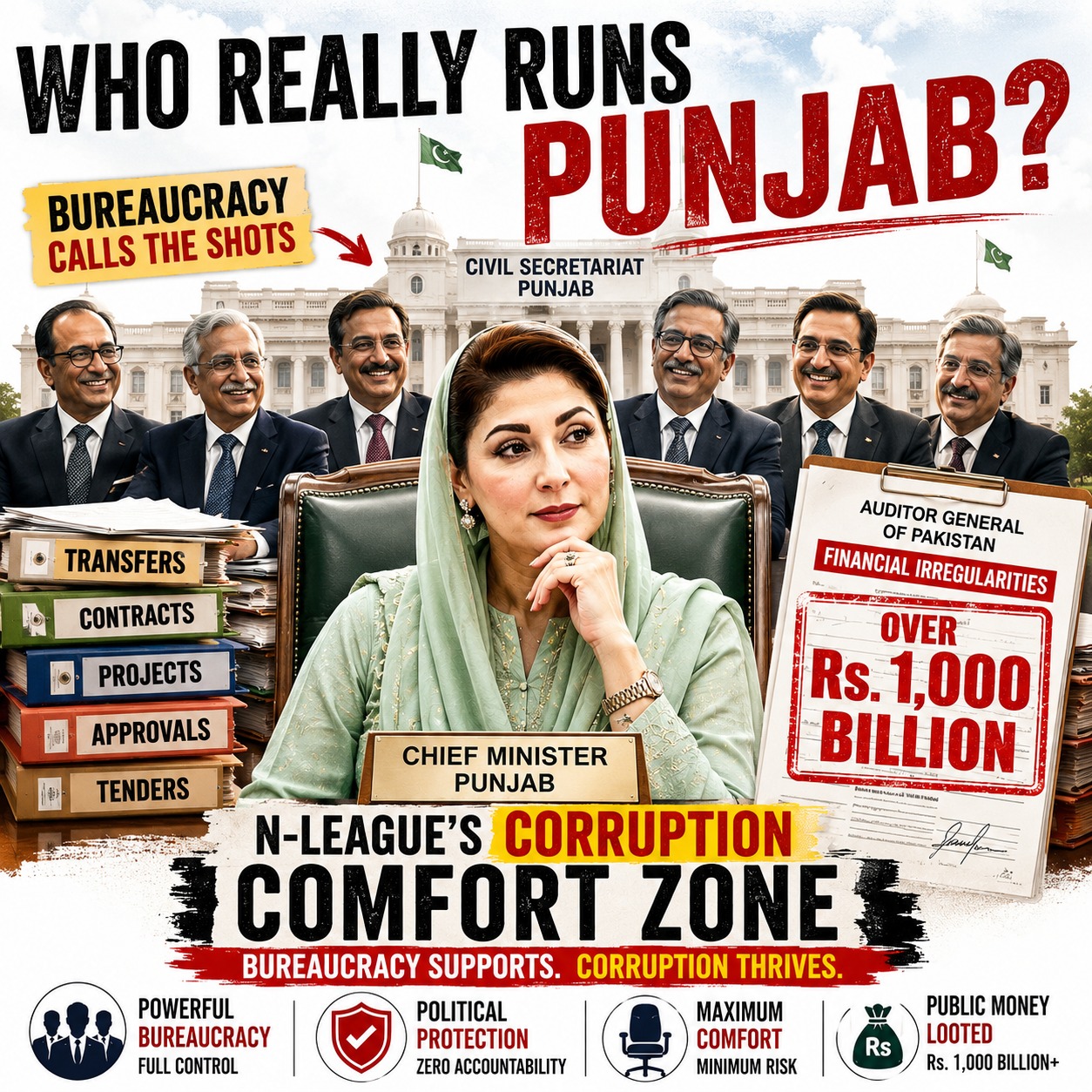
Same Incompetence, Different Bureaucracy: The Real Story of Punjab’s Governance Crisis
Usman Buzdar and Maryam Nawaz Sharif are equally incompetent leaders. The only meaningful difference between their tenures is that the bureaucracy worked against Buzdar and works with Maryam. That single variable “bureaucratic cooperation” explains everything people mistakenly attribute to leadership quality. Ask any analyst why Buzdar’s tenure was a disaster and Maryam’s tenure looks comparatively functional, and they will give you a long list: Buzdar had no vision, Maryam is energetic; Buzdar was invisible, Maryam is assertive; Buzdar could not deliver, Maryam launches schemes. But strip away the optics and one question stays: what changed? Not the leader’s competence. What changed was the bureaucracy’s willingness to cooperate.
Before comparing Buzdar and Maryam, one needs to see Shehbaz Sharif standard which say they prefer working under the “Shehbaz standard,” what they are really saying is: they prefer a leader under whom they could operate with political cover, benefit from proximity to power, and face minimal accountability. That is not a governance standard. That is a corruption comfort zone.
This culture produced what is known within Punjab’s bureaucracy as the “N Group” a clique of officers receiving preferential treatment, who played a key role in facilitating the rise of the Sharif family and who expect political loyalty to flow both ways. This is the bureaucracy that Buzdar couldn’t work with and that Maryam inherited.
Maryam Nawaz came to office with zero governance experience. She has never administered a department, managed a public budget, or run any institution. Her entire career has been political activism press conferences, rally speeches, and party organization. By any objective measure of administrative preparation, she is no more qualified to run Punjab than Buzdar was. But the N Group bureaucracy welcomed her home. Senior officers were of the view that if Maryam became Chief Minister, she would take the bureaucracy with her. They believed whoever came from PML-N would not face resistance if they balanced support and trust with the civil service. And so, the machine moved. Roads were built. Schemes were launched. Press releases were written. But who did the actual work? The same civil servants who had been there for decades, now running at full capacity because their political patron family was back in power. If bureaucratic cooperation were translating into genuine competent governance, the financial record would reflect it. Instead: the Auditor General of Pakistan’s audit report for 2024–25 uncovered financial irregularities of over PKR 1,000 billion in Punjab’s expenditureaccounts, including fraud, misuse of public funds, unauthorized payments, financial mismanagement, and suspicious procurement practices.
A cooperative bureaucracy operating under an incompetent and unaccountable leader does not become honest. It becomes bolder. The difference between the Buzdar and Maryam eras in this regard is not paralysed corruption versus clean governance. It is stalled plunder versus active plunder.
Punjab’s governance crisis is not a story of one bad chief minister followed by a better one. It is a story of a permanently politicized bureaucracy that decides, based on factional loyalty, whether to make a government succeed or fail. Under Buzdar, the N Group bureaucracy chose failure and got it. Under Maryam, the same N Group bureaucracy chose cooperation, and Punjab got the appearance of governance, with Rs1,000 billion in financial irregularities quietly running underneath. Buzdar and Maryam are two versions of the same fundamental failure: political leaders placed in power not because of capability but because of political calculations, propped up or undermined by a bureaucracy that answers to family loyalties rather than constitutional duty. The real question is: why does a province of 110 million people have its fate decided by whether senior civil servants in the Civil Secretariat feel comfortable enough to do their jobs? Until that question is answered and until Punjab’s bureaucracy is genuinely depoliticized; it does not matter who sits in the CM House. The same system will keep running. Only the names on the press releases will change.
Muhammad Arslan Shehzad
Political Activist lives in US
arslanshehzad@hotmail.com @arslanshehzd