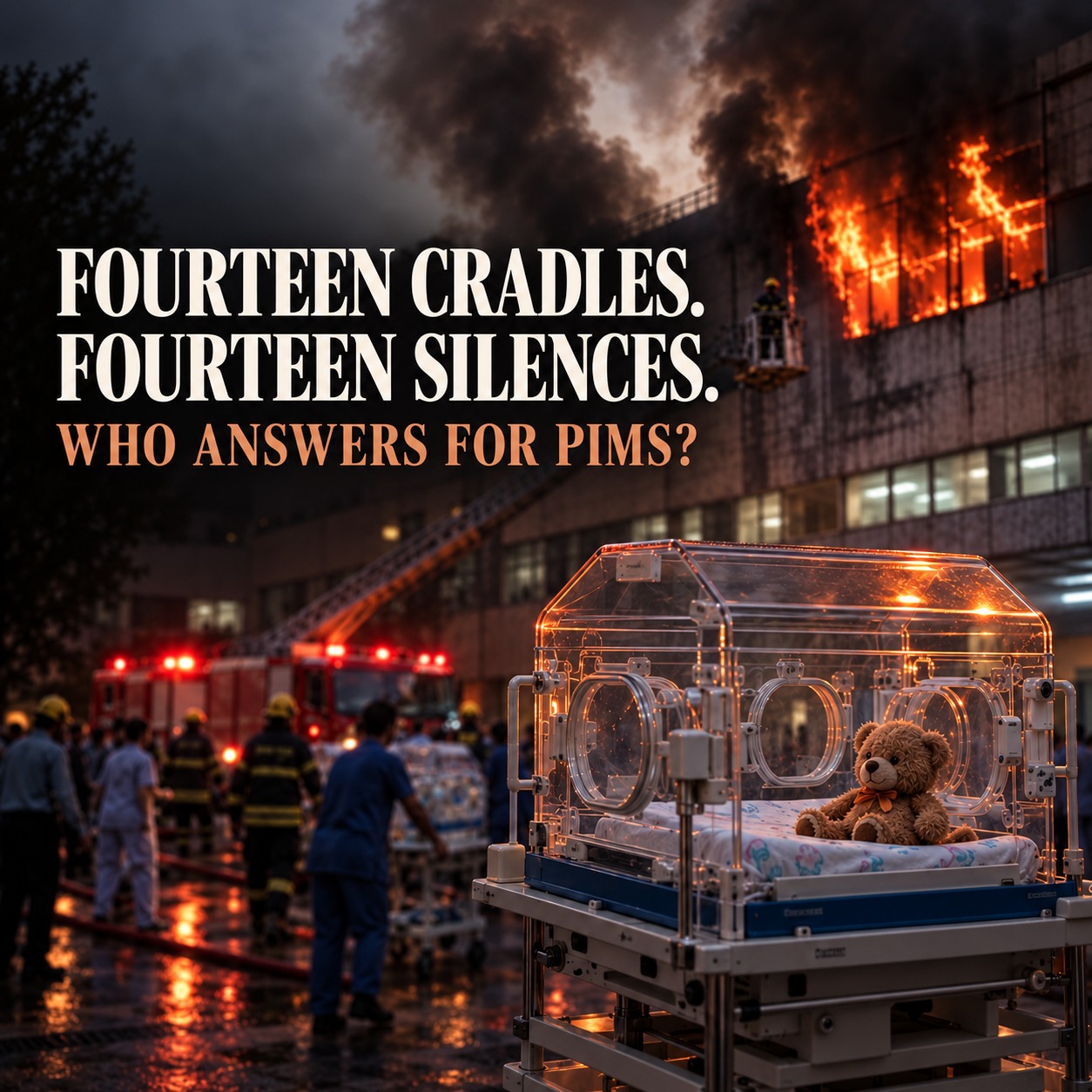
Fourteen Cradles, Fourteen Silences: Who Answers for PIMS?
On the morning of August 26, 2026, fifteen newborns lay in the nursery of the Mother and Child Health Centre at the Pakistan Institute of Medical Sciences in Islamabad, the capital's largest public hospital, a place where exhausted new parents trust that the most fragile among us will be kept safe. By 7 a.m., fourteen of them were dead.
A short circuit in an air-conditioning unit, hospital officials said. The blaze spread fast because of oxygen lines running through the nursery. Supervisory staff were not on duty when it started. Emergency services weren't even called for six minutes, and the first responders reportedly took fifteen minutes to arrive after that call went out, in a country where, by some accounts, doors to the ward were locked as parents tried to get in.
One baby girl was pulled out alive. Four others and three mothers were rescued from an adjoining room. Seventy-three patients from the neighboring gynecology ward were moved to
safety. And still, fourteen families buried children who had been alive for hours, or days. Among them were twin girls, three days old, whose father, a vegetable seller who had gone
home to rest while his wife recovered in intensive care. He learned of his daughters' deaths before his wife passed away from the shock as well.
A Warning Already Given
This is the part that should make every Pakistani's blood run cold: we have been here before. In June 2024, eleven babies died in a nearly identical fire at Sahiwal Teaching Hospital in Punjab. That fire, too, was traced to electrical failure. That fire, too, exposed expired fire extinguishers and absent oversight. Arrests were made. Promises were issued. Inquiries were commissioned. Two years later, fourteen more infants are dead in the nation's capital, inside a flagship federal institution, for reasons that sound almost identical: aging infrastructure, absent supervision, and a system that treats the safety of newborns as an afterthought rather than a non-negotiable baseline.
A government that had actually learned from Sahiwal would have audited every neonatal ward in the country. It would have replaced wiring, inspected oxygen lines, mandated fire drills, and made sure a nursery was never again left without senior staff present. None of that happened. And so it happened again, this time in Islamabad, under the direct gaze of the people who are supposed to run this country.
Who Is Actually Accountable?
In the aftermath, the choreography was familiar. The prime minister expressed sorrow. A health secretary was suspended. Then eight more officials. There is talk of criminal proceedings. Civil society groups have asked the courts to take suo motu notice. But suspending officials after the babies are already in the ground is not governance, it is damage control. And it raises the harder question that so many Pakistanis are asking in private and in public: what does accountability even mean to a government whose own legitimacy so
many of its citizens have never accepted?
These are children who never got the chance to become doctors, engineers, teachers, the future workforce, the future parents, the future of this country. Their deaths are not an abstract
policy failure. They are the direct, foreseeable consequence of a state that has, again and again, been too consumed with staying in power to attend to the basic function of keeping its
people alive.
A Question of Consent
There is a reason this tragedy has struck such a raw nerve beyond the grief itself. This is not idle cynicism about politicians in general, it is a specific, documented grievance. The February 2024 election that brought this coalition to power was marred by the Form 45/47 controversy, in which opposition candidates presented original polling-station results that did not match the figures later issued by returning officers, in dozens of constituencies.The delay in announcing results, the shutdown of mobile networks on polling day, and the scale of the discrepancies were serious enough that the United States, the United Kingdom, and the European Union all publicly called for an independent inquiry into the vote's fairness. A caretaker prime minister himself was later accused of hinting at what Form 47 truly concealed.
None of that has been undone. And the man millions of Pakistanis actually voted to lead them has instead spent the years since this government took office behind bars. That is the throughline: a mandate that was never honestly earned, followed by a bureaucracy that treats the public the way it treats everything else it did not have to fight for, with negligence, because negligence carries no political cost when you were never going to be voted out to begin with. A hospital nursery left without senior staff on duty.
Fire extinguishers left to expire in Sahiwal. A shopping mall in Karachi that turned into a pyre killing 67 people earlier this year. A rising tide of violence against women and children that barely makes the evening news anymore because it has become so routine. None of these are isolated accidents. They are what happens when the people running a country do not believe they answer to the people living in it.
What Fourteen Names Demand
Bahadur Khan's twin daughters were three days old. Twelve other children died alongside them, each one somebody's whole world, each one part of the generation that was supposed to carry this country forward. They deserve more than a suspended secretary and a promised inquiry that will, like Sahiwal's, fade from the news cycle within weeks.
They deserve a government that was actually chosen by the people it governs, because only a government that fears the ballot box has any real reason to fear failing its citizens. Until
Pakistan gets that back, this will not be the last fire. It will simply be the last one anyone bothered to be surprised by.